A big tree fell during last winter’s windstorm. It’s top got caught up in some other trees and the trunk is at a 45 degree angle across a path I’d like to use to bring in some other wood. Clearly I should cut down this tree. But how do you cut a tree that’s neither upright nor lying down?
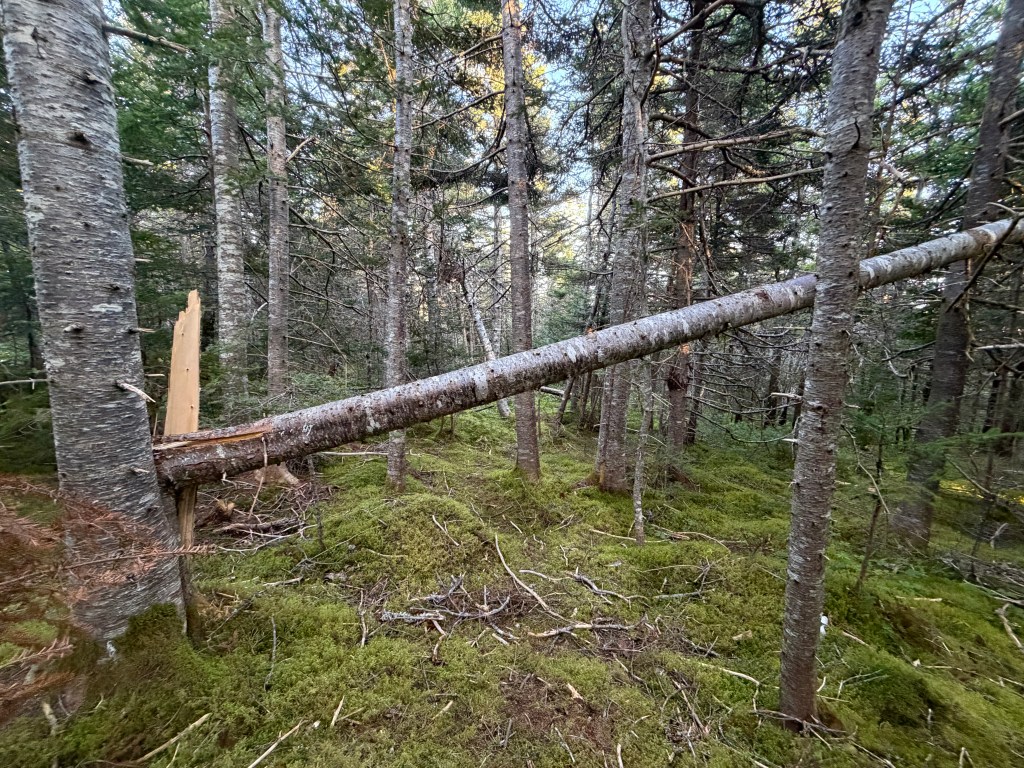
The problem I can perceive is that if I cut straight down like you would a horizontal trunk, it will pinch my saw by the time I get half way. All the weight of the tree, held down by gravity, versus my (relatively) little arms trying to yank the saw out. I would lose, and I would literally lose my saw.
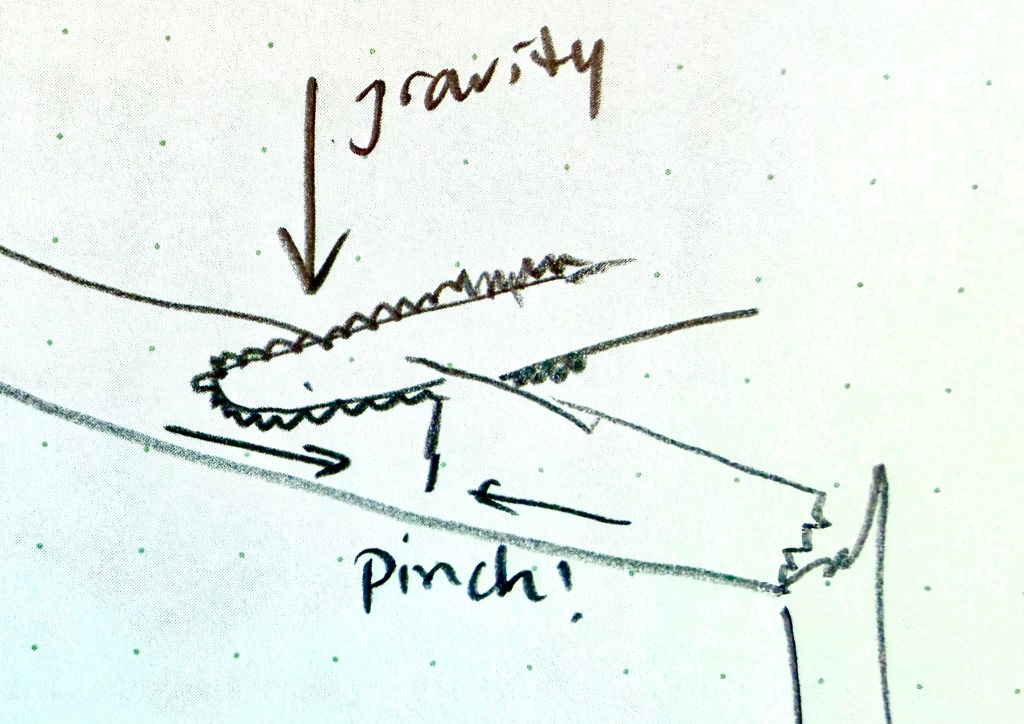
I called dad, and he confirmed. If that happens, you have to go get another saw to cut out your saw. How embarrassing. You also still have the original problem of compression. Also, how do you stop a chainsaw from messing up the chain of the other saw once they get close? Let’s avoid all that.
Dad talked me through another scenario for cutting without getting your saw pinched, particularly if the tree is more standing up than laying down. As you cut, you put wedges in behind the saw, which opens up the cut. You keep adding more and more wedges, pounding them deeper into the cut, until your saw pops out the bottom. It’s now very likely that the tree stays exactly as it was as the two cut sides are compressed together with the wedges in the middle. So like the image above, but with wedges instead of a saw.
This means you still have a tree at a diagonal, and you have to somehow get the two sections to split. Often what you do is cut it again, so there are two cuts and three tree sections, all pinched together. Then you knock out the middle piece. And look out for all three sections of the tree blasting off in various directions.
Dad said there is another way, especially if the tree is more horizontal than vertical. You cut from the bottom. Just the normal chainsaw set up, but you’re pulling the saw up through the tree instead of down. The tree still pinches at the bottom, but your saw is hopefully ahead of the pinch as it moves up.
That’s the technique. It does not communicate how worried dad was about this whole situation. His first words were: “You don’t know where the tree is going to move,” followed closely by, “it will probably want to move backwards, towards its own trunk, so don’t stand behind the trunk because as soon as the pressure is released it will fly back and punch out your legs and you will die.” I am paraphrasing, but only mildly.
We then talked about how trees that are caught up in other trees have a lot of pressure coming from various places. The most important and unpredictable is where and how the fallen tree is caught up. It will have bent the trees it has fallen into, and those trees would like to straighten up again. But if there are multiple trees, “straightening up” might be left or right, but certainly back towards the original tree as the bent host trees spring back into their original position, like a catapult (hence the trunk violence).
There’s also gravity. And there’s not a way to tell whether gravity will be stronger than the other forces, but they usually work in concert. He said the wedge method of cutting didn’t change this, and you additionally had to worry about the forces when you knock out the middle section. And the cutting from the bottom method results in “the tree moving quickly, all at once.” Both sound terrifying.
So after promising my dad that I’d call my neighbour before and after I cut the tree incase he had to find me bleeding out in the woods, I went to look at this tree again.
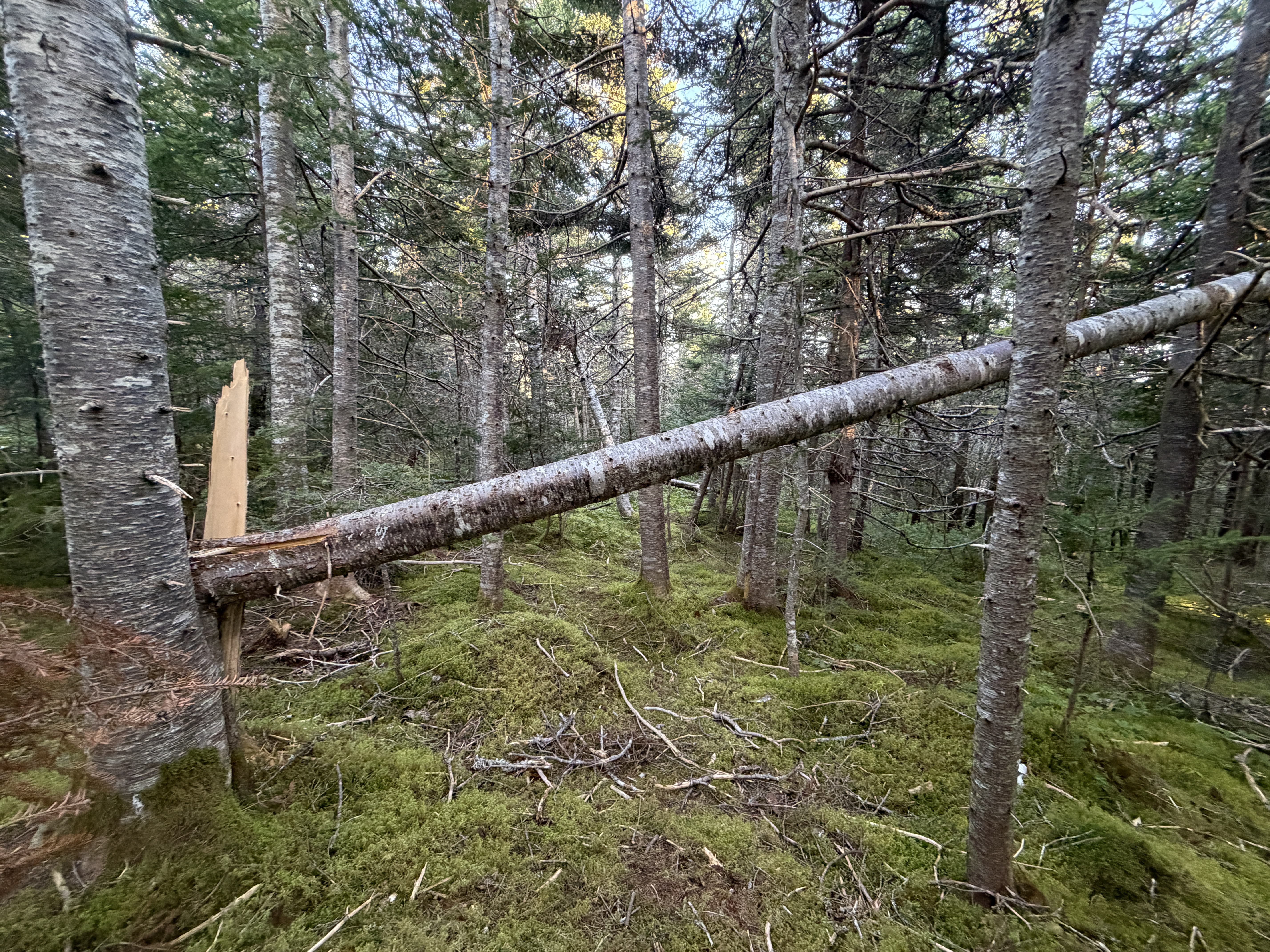
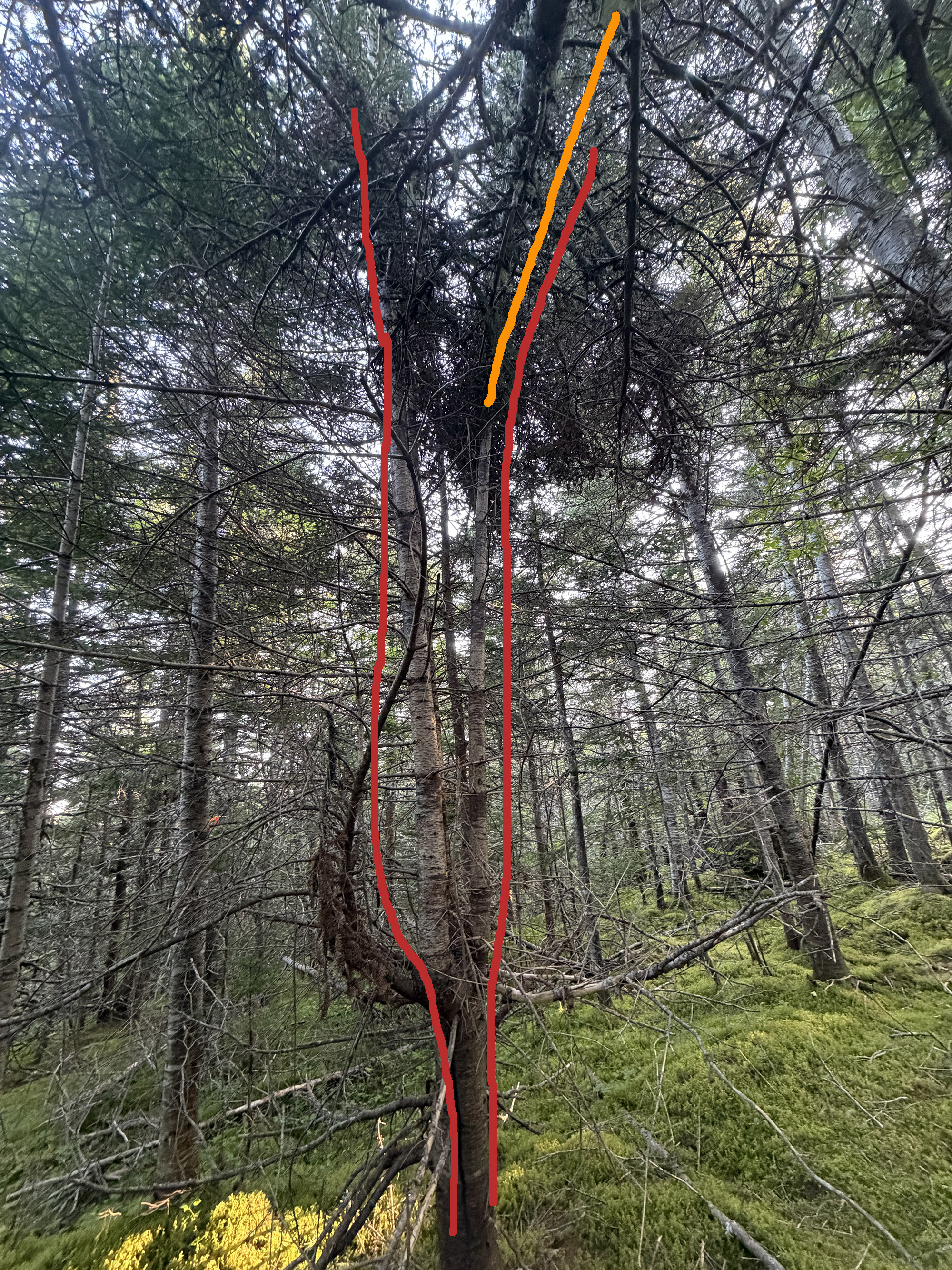
I’d not really looked at how the tree was hung up before. It had fallen into an extremely rare case of a pine tree that had split into two forks due to some previous damage, right in the crook. In the photo above, the fallen tree is marked in orange and its new host is marked in red. There was no way I was going to push the tree down to a horizontal position by jumping on it (this had been my first plan). The top of the fallen tree was not going to fly left or right, but it was certainly going to be pushed backwards towards its trunk when the tree holding it straightened back up. The part of the fork that was holding it up was quite bent over.
The original fallen tree was also a unique case of a pine tree that had split into a fork (what are the odds?!) but it had split at the base. So as the tree trunk was forced back, its base would either shoot out to the right where there was space, or go to the left, hit its second trunk, and shoot off who knows where.
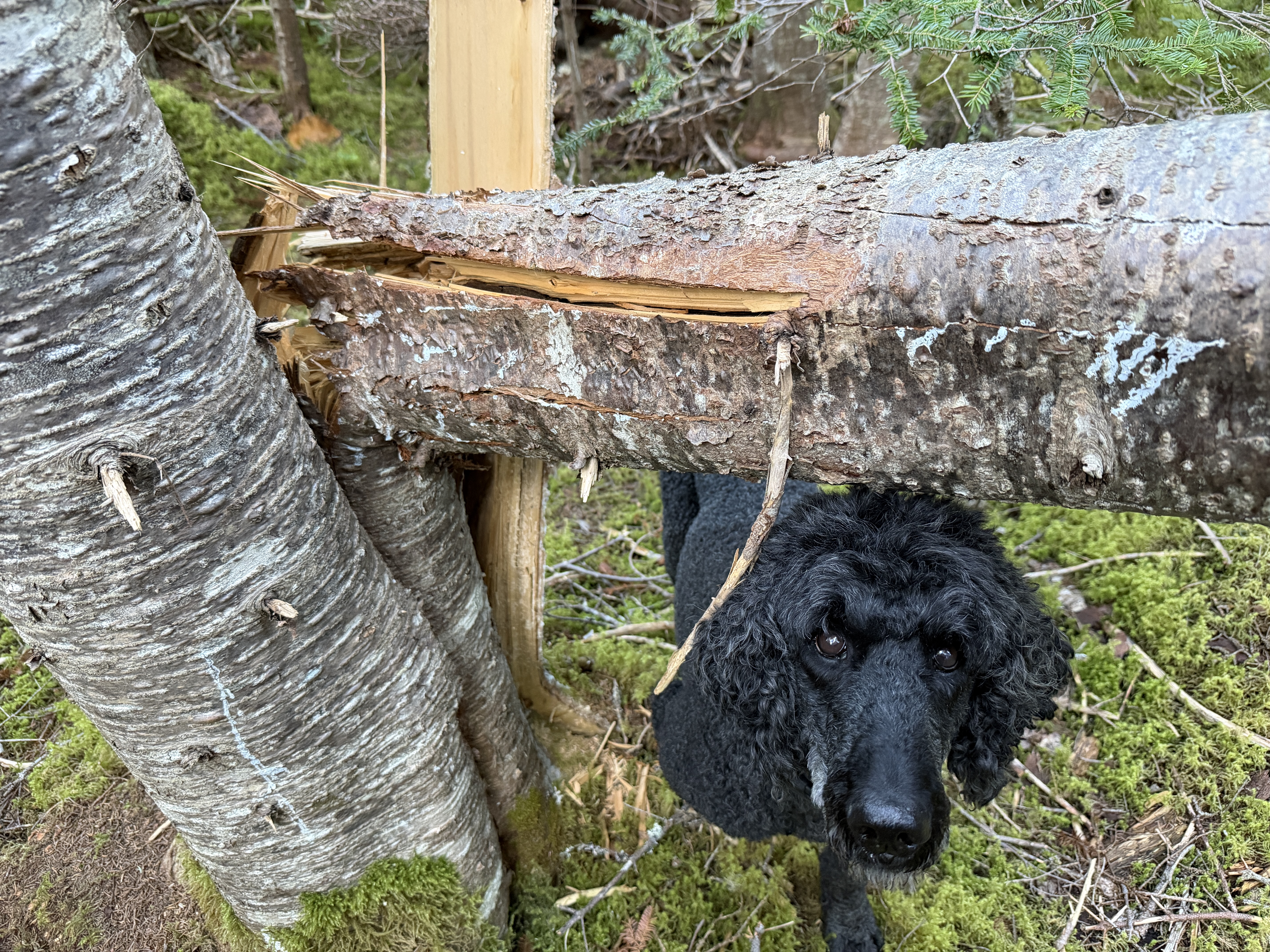
Don’t worry. Kookum the dog is safe in that last photo. I put a lot of work into trying to make the tree come down on its own, and unfortunately it is extremely stable.
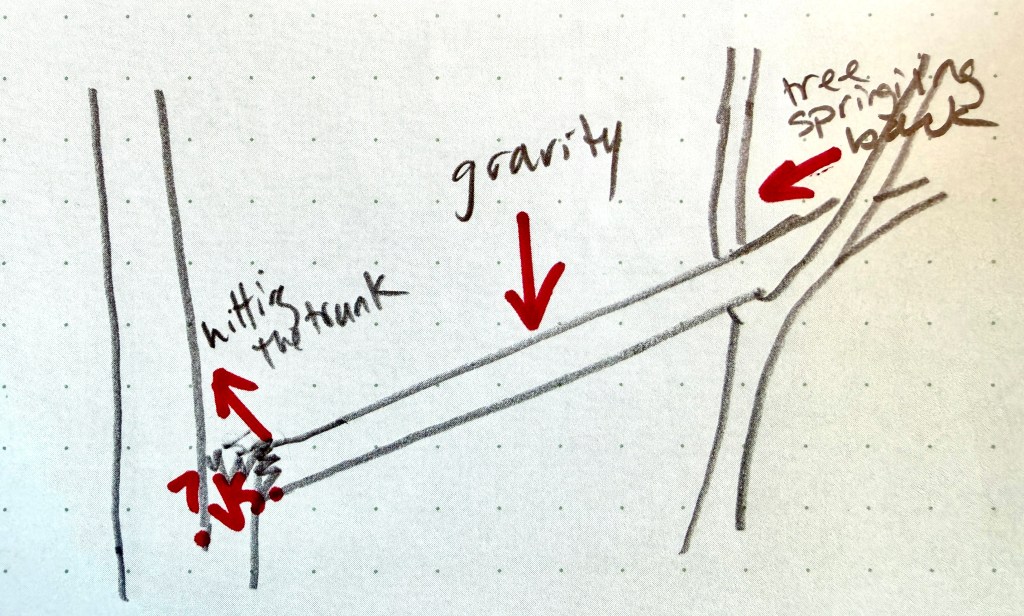
These are (I think) the main forces that will push the tree around once it’s cut. But: I have no idea how strong they are relative to one another. I don’t know if gravity will be dominant and mostly push it down with some swaying, or whether it will shoot out backwards like a cannon before slumping to the ground (or even staying mostly caught up in the tree). I don’t know exactly where the danger is, only that there is a lot of it.
The tree is very big, and I am very small and soft. There is also a chainsaw in the mix, getting torqued and twisted, in addition to a battering ram tree trink going in unknown directions.
I decided not to cut the tree.
