Generally, I’m skeptical about hope. I think of it as toxic optimism, or naivety. But I may be changing my mind?
In “Ordinary Hope,” Steve Jackson explains why I might have been skeptical to begin with: lefties, starting with Marxists, “approach hope, whether in religious or secularized form, as a form of idealism or mystification that obscures recognition of the essential structural conditions of the world, including those upholding unequal social orders. In this line (but with exceptions returned to shortly), where hope appears it is more likely to be framed as a kind of deception or false consciousness (Lukacs, 1972 [1920]), propagated and sustained through the emergence of the modern culture industries (Horkheimer and Adorno, 1947), the actions of ideological state apparatuses (Althusser, 1971), or other powerful instruments of culture and ideology” (Jackson, 2023: 420). Oh right. Yes, well. That. But maybe sounding less like a jerk? No?
This critique isn’t wrong, but nor is it as complete as it’d like to be (and part of the problem is that it would really like to be complete).
It turns out there are a lot of cultural traditions of hope, and not all of them have been the tools of controlling capitalism or macho universalism (Jackson, 2023). I’m still wary of the term, since, like “decolonization” or “be nice” it covers–in both range and concealment–a lot of uneven ground and opposing politics.
But the concept, and more importantly the practice, of hope is usually found in the company of loss, grief, resilience, worldmaking, and orientations towards a better future when the present is a struggle. That orientation can be individual or collective, feasible or impossibly idealistic, extractive or repairing, righteous or generous, but those properties are not inherent to hope.
In “Ordinary Hope” (2023), Steve Jackson lays out the kind of hope that pairs well with repair (his term) and humility (my term) in a “broken world” (definitely his term) that “draws energy from a politics of material participation (Marres, 2012)” (430). That is, he articulates a type of hope that relates to chores. He argues:
- That hope is not predictive (and can therefore be disappointed but never falsified or disproved, whether by history or critique).
- That the measure of hope is not accuracy, but efficacy: its ability to hold and sustain more meaningful forms of action and relationality in the world.
- That hope may be expressed in orientations towards change and transformation, but also in forms of modest patience and enduring (which are not fully reducible to passivity, resignation, or ‘mere’ waiting).
- That hope is above all a property of ordinary work – a characteristic of our ongoing ongoingness in and with the world – from whence comes it [sic] depth and power.
- And that hope is a collective accomplishment – something we do in and with the world, in concert with others and with things.” (Jackson 2023: :421)
In other words, hope is a chore. 🙂
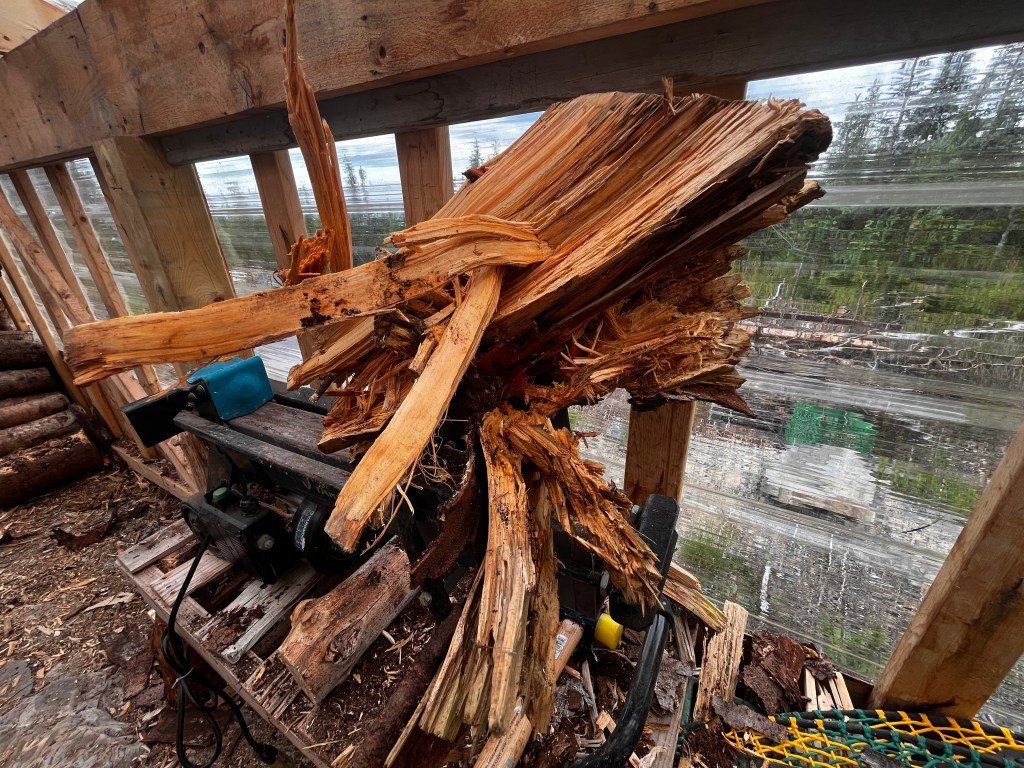
Wooding always happens in a world of climate change, environmental degradation, and all the fears and griefs that accompany those. It even makes that world sharper, more specific, because it teaches you exactly how the forest is doing, how the wood is changing, about the smoke in the air from wildfires while you haul fuel out of the forest.
It is, above all, “ordinary work… in concert with… things” (421). It is repetitive with responsive variation, where that variation always follows the concert of material things: the wood, the woods, weather. Getting a call from your friend’s, wife’s ex to come get some extra wood. Hauling it up a very steep hill, into the truck, whose bed is uneven. Unloading it into a shed. Splitting, splitting, splitting, with each split a little different depending on where the knots are, the width of the round, how dry it is. Stopping to let the bugs escape.
And wooding as an ongoing, regular, seasonal chore certainly “hold[s] and sustain[s] more meaningful forms of action and relationality in the world” and this is the point of this blog. I’m still clumsy at articulating this, but in as unromantic terms as possible, I don’t think you can wood without being in relation with wood. The fucking sap will correct you. The branches are heavy and will fall on your head. The tree will not always fall in the direction you’ve so carefully set up (please wear a hard hat). Those logs are bloody heavy. Some of the bugs bite. At the very least, wooding–by which I mean long term, even inter-generational wooding– teaches you humility: that your master plans and orientation towards your desired future are not actually yours to control or even claim, because you are tied to the world and all its things.
It might be overstating it to say that wooding enforces humility, but not by much.
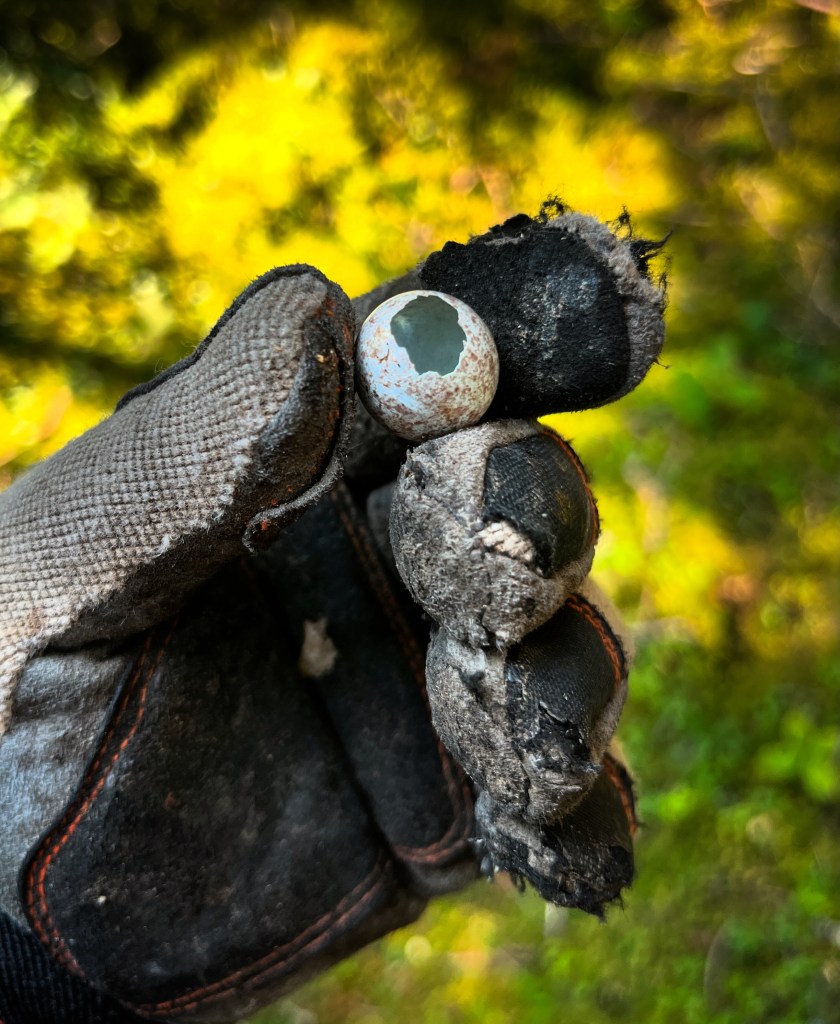
Here, I mean humility in a way I’ve written about it before, with folks from my lab, CLEAR:
Humility comes from the understanding that our world is interconnected. Being humble means that we—as members of larger groups of humans and others—recognize that we are not singular nor superior in our knowledge, perspective, experience, or social position, and that we are connected to others (whether we want to be or not). It is another way to say “we are all connected” or “all our relations” or similar ideas from different cosmologies. Yet, these connections and relations are not all even, and humility also entails an intelligence (emotional, intellectual, relational) about how we are connected, why, and to whom, and how these connections vary. (CLEAR 2021: 8. Emphasis in the original, since it’s a teaching text)
Humility, in other words, is recognising how you are always in the hot mess of constantly shifting complexities of being in relationship with and to other things. (It is, in many ways, the opposite of modesty. Modesty means not talking about your accomplishments, which are always, always collective accomplishments because of all of these connections. So denying your accomplishments, your successes, your good stuff, is also denying the labour, value, and character of your relations. And that is being a jerk. Humility is relational honesty. But I digress–which I can do in a blog, so that’s great).
I think humility, chores, and hope come together in a strong trio. If “hope may be expressed in orientations towards change and transformation, but also in forms of modest [sic]patience and enduring (which are not fully reducible to passivity, resignation, or ‘mere’ waiting)” (Jackson, 2023: 421) then that is a more humble orientation than some of the more toxic forms of hope. It is the hubris of overdetermining the future–individualistic desires of mastery and control–that ends to put me off popular expressions of hope.
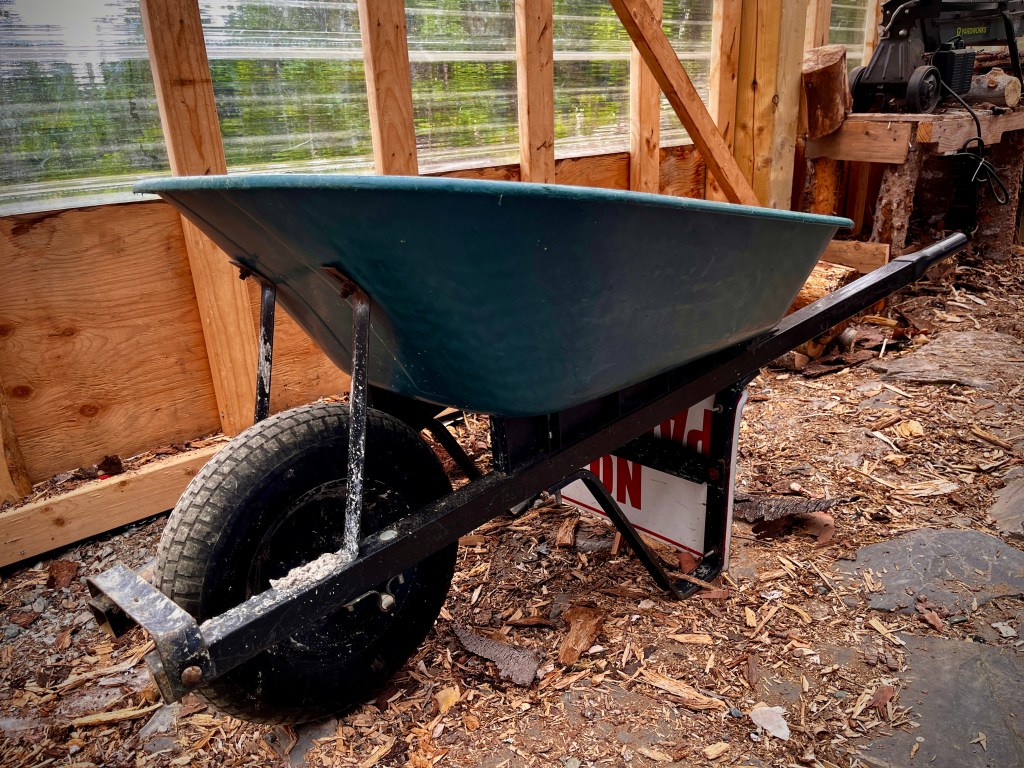
The humility of navigating complex but ordinary material relationships–which are unavoidable while hauling wood uphill in a cheap wheelbarrow–helps imagine an active patience, a resilient and collaborative form of endurance that is less sighing-wistfully-at-the-window-in-a-nightgown and more cursing-the-wonky-wheel-while-being-grateful-for-the-wood. It’s patience that puts you into the world rather than above it, a slow and unmasterful orientation towards change because this wheel barrow sucks.
I think there is a lot more to say about the temporalities of wooding, chores, change, and the future. But this is good for now.
References
Jackson, Steven J. “Ordinary hope.” In Ecological reparation, pp. 417-433. Bristol University Press, 2023.
CLEAR. CLEAR Lab Book: A living manual of our values, guidelines, and protocols (Version 3). Memorial University, 2021.
